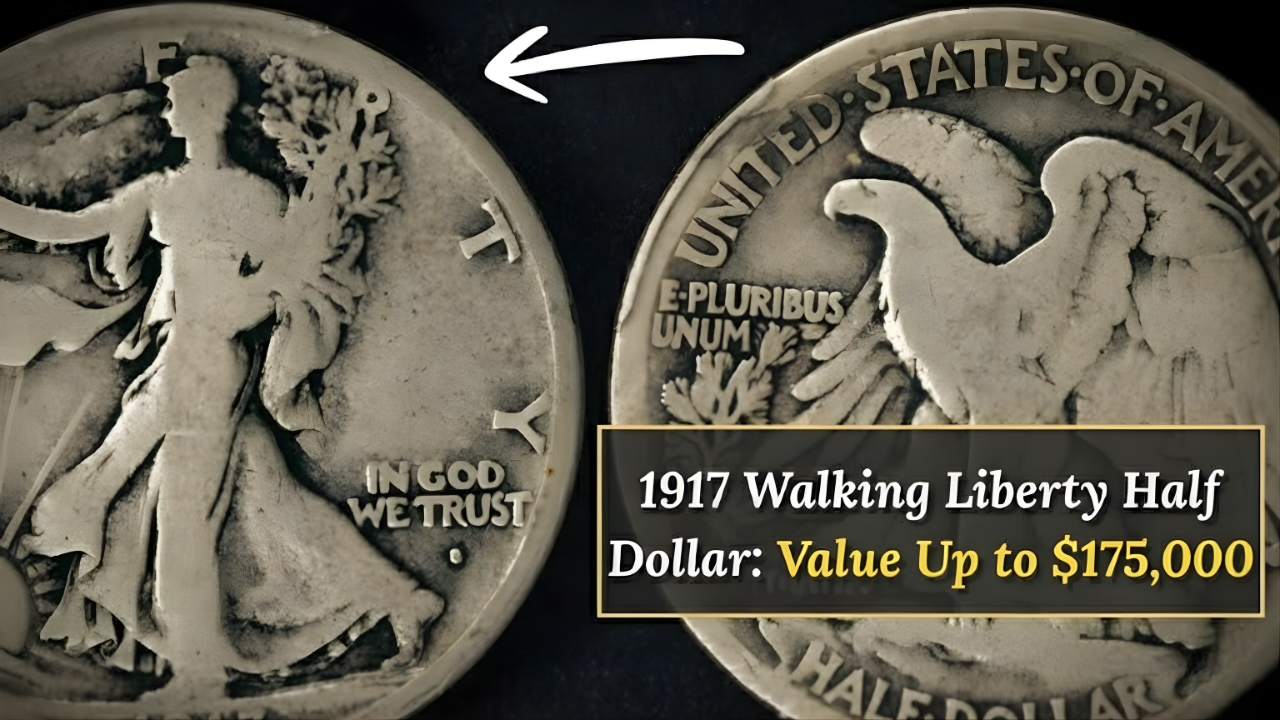
The Walking Liberty Half Dollar is widely regarded as one of the most beautiful coins ever produced by the United States Mint. Among all the dates in this celebrated series, the 1917 issue stands out as one of the most closely watched by collectors.
Certain 1917 Walking Liberty Half Dollars have sold for prices reaching as high as $175,000, a figure that continues to spark excitement and renewed interest across the numismatic world. This remarkable valuation has collectors carefully examining their holdings and learning what truly separates an ordinary coin from a six-figure rarity.
The Birth of the Walking Liberty Half Dollar
The Walking Liberty Half Dollar was introduced in 1916 as part of a broader effort by the U.S. Mint to refresh American coinage with more artistic designs. Sculptor Adolph A. Weinman created the iconic image of Lady Liberty striding confidently toward the rising sun, draped in the American flag and holding branches of laurel and oak. The reverse featured a powerful bald eagle perched on a rock, symbolizing strength and resilience.
From the moment of its release, the Walking Liberty Half Dollar was praised for its elegance and symbolism. It quickly became a favorite among the public and collectors alike. The design was used from 1916 through 1947, but early years, particularly 1917, are among the most challenging to find in high quality today.
Why the 1917 Issue Is So Important
The year 1917 was unique for the Walking Liberty series because it featured multiple design variations and minting challenges. That year saw the production of both obverse and reverse mint mark styles, creating distinct subtypes that collectors actively seek. These variations add complexity to the series and make the 1917 issues especially intriguing.
Coins from this period were heavily used in everyday commerce, especially during the economic demands of World War I. As a result, many 1917 Walking Liberty Half Dollars circulated extensively, leaving few examples in pristine condition. This combination of historical context and design variety contributes significantly to the coin’s desirability.

Understanding Mint Marks and Varieties
Mint marks play a crucial role in determining the value of a 1917 Walking Liberty Half Dollar. Coins were produced at the Philadelphia, Denver, and San Francisco mints, with each location contributing different quantities. In addition to mint location, 1917 halves are known for having mint marks placed either on the obverse or reverse, depending on the specific variety.
These differences may seem subtle to the untrained eye, but they can dramatically affect value. Some varieties are far scarcer than others, especially when found in high grades. Collectors seeking complete sets must acquire each combination, which drives competition and pushes prices higher for the most elusive examples.
The Role of Condition in Reaching Six Figures
Condition is one of the most critical factors in determining how a 1917 Walking Liberty Half Dollar can reach values as high as $175,000. Most surviving coins from this era show significant wear, with softened details on Liberty’s gown and the eagle’s feathers. Finding a coin with sharp details, full luster, and minimal marks is exceptionally difficult.
Coins graded at the highest levels by professional grading services represent a tiny fraction of the total mintage. These top-tier examples are often considered condition rarities, meaning they are rare not because of low production numbers but because so few survived without heavy wear. When one of these exceptional coins appears on the market, collectors are willing to pay extraordinary prices.
Professional Grading and Market Confidence
High-value coins rely heavily on professional grading for credibility. Independent grading services evaluate a coin’s authenticity, condition, and surface quality before assigning an official grade. For a coin to command a six-figure price, buyers must have complete confidence in its legitimacy and preservation.
A 1917 Walking Liberty Half Dollar graded at the highest levels often becomes a centerpiece of elite collections. The combination of an iconic design, early date, and top-grade certification creates a powerful appeal that few collectors can resist.
Silver Content and Intrinsic Value
All Walking Liberty Half Dollars were struck in 90 percent silver, giving them intrinsic value based on precious metal content. While silver alone does not account for prices approaching $175,000, it adds a foundational layer of desirability to the series.
Collectors often appreciate the balance between intrinsic and numismatic value. The silver content ensures a baseline worth, while rarity, condition, and demand determine the premium. For early dates like 1917, this balance makes the coin attractive to both traditional collectors and those focused on precious metals.
Historical Context and Wartime Circulation
The 1917 Walking Liberty Half Dollar was minted during a turbulent period in American history. The United States had entered World War I, and the economy was shifting to support the war effort. Coins were produced and circulated heavily to meet commercial needs, leaving little consideration for long-term preservation.
This heavy use explains why so few high-grade examples exist today. Coins were handled frequently, stored carelessly, and exposed to harsh conditions. Each surviving high-quality 1917 half dollar serves as a tangible link to this pivotal era, adding historical weight to its numismatic appeal.

Collector Demand and Competitive Auctions
Collector demand plays a powerful role in pushing prices to record levels. Advanced collectors often compete fiercely for the finest known examples of key dates. For some, owning the best available 1917 Walking Liberty Half Dollar represents the ultimate achievement within the series.
Auction environments amplify this competition. When two or more determined collectors pursue the same rare coin, prices can rise dramatically. The $175,000 valuation reflects not only objective rarity but also the intense desire to own a piece of numismatic excellence.
Common Myths About Valuable Walking Liberty Halves
Stories of high-priced coins often lead to misconceptions. Many people assume that any 1917 Walking Liberty Half Dollar is automatically valuable, which is not the case. Most circulated examples, while still collectible, are worth far less than six figures.
Value depends on a precise combination of date, mint mark, variety, and condition. Without these elements aligning perfectly, a coin’s worth remains relatively modest. Understanding this helps collectors appreciate why only a select few coins reach extraordinary prices.

How to Examine a 1917 Walking Liberty Half Dollar
Careful examination is essential when evaluating a 1917 Walking Liberty Half Dollar. Details such as Liberty’s hand, gown lines, and the eagle’s feathers provide clues about wear and preservation. Mint mark placement must also be verified, as it determines the specific variety.
Coins should always be handled by the edges and never cleaned. Cleaning can permanently damage surfaces and erase valuable original characteristics. If a coin appears especially sharp or unusual, professional evaluation is strongly recommended.
The Enduring Legacy of the Walking Liberty Design
The Walking Liberty design remains a cornerstone of American numismatics. Its influence extends beyond the half dollar series, inspiring modern bullion coins and commemorative issues. Collectors continue to admire its artistry and symbolism more than a century after its introduction.
The 1917 issue occupies a special place within this legacy. Its combination of early production, historical context, and variety complexity makes it one of the most studied dates in the series. High-value examples serve as benchmarks for quality and rarity.
Why Early 20th Century Coins Still Matter
Coins like the 1917 Walking Liberty Half Dollar demonstrate why early 20th century coinage remains relevant today. These coins bridge the gap between classical artistry and modern minting practices. They also reflect moments in history that shaped the nation.
Collectors value this connection as much as the physical coin itself. Owning a rare 1917 half dollar means preserving a small but meaningful piece of American heritage, which adds depth to its monetary value.
Final Verdict
The 1917 Walking Liberty Half Dollar worth up to $175,000 stands as one of the most compelling examples of how rarity, condition, history, and collector demand intersect. While most examples are far more modest in value, a select few preserved in exceptional condition have achieved legendary status.
These coins remind collectors that true treasures are defined not just by age, but by survival, craftsmanship, and enduring appeal. For those passionate about numismatics, the 1917 Walking Liberty Half Dollar remains a symbol of both artistic excellence and the extraordinary heights a coin can reach.
Disclaimer
This article is provided for informational purposes only. Coin values vary based on condition, rarity, market demand, and professional authentication. The $175,000 valuation represents exceptional cases and is not typical for all 1917 Walking Liberty Half Dollars. Readers should seek professional appraisal and grading before making any collecting or financial decisions.